The Assassin's Footprint

It is to be remembered that a person's footprints are as well known as his face – Lorna Marshall, The !Kung of Nyae Nyae, 1976.

You will know a man by the impressions he leaves behind. Deep or shallow; a long gait or a short stride; the force of his movement—keen observers pay careful attention to the impact and breadth of his arrival. The road not traveled becomes well-trodden ground under his feet, and you learn from the depressions left in his wake.

The common occupation of the adult forager man is to hunt, and the hunt requires a specific set of skills, strategies, and equipment. Anthropologist George Murdock described the tool technology of the Aranda hunter-gatherers of Australia, writing that,

The weapons of the chase and of war are manufactured mainly of stone and wood…Knives are of chipped stone, either held in the hand or attached with resin to a wooden handle. An ax or an adze consists of a carefully ground stone head hafted with resin to a piece of wood forked at the end. A point of stone or wood spliced and bound with tendons to a wooden shaft about ten feet in length, the whole often equipped with barbs, constitutes the Aranda spear. A unique and exceedingly useful implement is the spear-thrower, a leaf-shaped and often concave piece of hard wood about two feet long tapering at one end to a narrow handle and at the other to a blunt point, to which is attached by a tendon a short sharp wooden point. This fits into a hollow in the end of the spear and propels it with much greater force and leverage than the arm alone could impart. On the handle end is fixed with resin a sharp piece of quartz, which forms the principal cutting implement of the natives…As projectile weapons the Aranda also use flat curved sticks or boomerangs, not, however, of the returning type. Shields are fashioned of light wood or bark with a concave inner surface and a longitudinal bar as a handle.

From Our Primitive Contemporaries (1934) by George Murdock.

From Our Primitive Contemporaries (1934) by George Murdock.

Murdock also gives a description of Aranda hunting tactics:

The men kill brush turkeys, pheasants, snipe, geese, ducks, pigeons, cockatoos, eagle-hawks, and other birds with their boomerangs. They usually stalk the kangaroo, creeping up cautiously and halting when the animal looks up, until they are close enough to hurl their spears. Sometimes several hunters combine to drive a kangaroo into an ambush, and occasionally fire is employed for a similar purpose. To catch the rock wallaby, which follows definite runs, a man will lie in wait patiently for hours. To trap the emu or Australian ostrich, a pit is constructed on its feeding grounds, a spear fixed upright at the bottom, and the top covered with brush and earth. Sooner or later a bird steps on the bushes, breaks through, and is transfixed by the spear. Sometimes a native poisons a water-hole frequented by emus with pituri, a narcotic drug, and hides in the vicinity until a bird drinks and becomes stupefied. Occasionally, too, relying upon the natural inquisitiveness of the emu, a man carries a pole resembling the long neck and small head of the bird and imitates its aimless movements, until it advances to investigate and he can throw his spear at close range.

From The Australian Aboriginal (1925) by Herbert Basedow

From The Australian Aboriginal (1925) by Herbert Basedow

The weapons and tactics involved illustrates some important patterns: these acts of physical violence are carefully planned, taking a significant amount of time to develop during the process of stalking prey, but are enacted rapidly with great lethality when opportunity strikes. Patience is required, and strategies of deception and ambush are often utilized.

It is not difficult to see how these tools and skills can also be used in intra- and intergroup conflict. A man who engages in violence strategically in the appropriate context may reap great rewards, while careful deceptions and an abrupt ambush can reduce the chance of reprisal.

Which brings me to a very important type of footwear found among the Aranda and other Central Australian forager populations. P.M. Byrne described the Kurdaitcha shoes thusly:

They consist of a sole made of human hair and a great number of intertwined emu feathers, a certain amount of human blood being used as a kind of cementing material. The whole form a large pad, flat above and convex below, with the two ends rounded off so that there is no distinction between them. The upper part is in the form of a net, made of human hair, with a central opening for the foot, across which stretches a cord of hair which serves as a strap for the instep.

Anthropologist Walter Baldwin Spencer adds that,

it is by no means an easy matter to make the shoes and, as usual, in the manufacture of any special article, there are certain individuals who are famed for their skill in making them. No woman or child may see them and they are kept wrapped up in skin or else placed for safety in the sacred store house along with the Churinga [male cult objects]. It is said that they may be used more than once, but the nature of the shoe is such that it could not last more than one journey over the hard ground characteristic of the interior.

Further, the right to wear the shoes must be earned, and comes at a cost. Spencer goes on,

Before a man may wear the shoes he has to submit to a most painful ordeal. A stone is heated to redness and then applied to the ball of the small toe of either foot, it does not matter which, until, as the natives say, the joint is softened when with a sudden jerk, the toe is pulled outwards and the joint is thus dislocated. There is no doubt that some such ordeal as this is passed through, as we have examined feet of men who claim to be what is called Ertwa Kurdaitcha at Charlotte Waters, Crown Point on the Finke River, Owen Springs and Alice Springs amongst the Macdonnell Ranges, all of which show the remarkable peculiarity of the dislocation. In correspondence with this is the fact that the true Kurdaitcha shoe has, at one side, a small opening made in the hair network through which the toe is thrust.

The male secrecy oriented around the shoes, as well as the costly ritual required to wear them, is similar to various practices found across other small-scale societies with ‘men’s cults’, as I’ve described previously. The key parallel, however, is that much like the hangahiwa wandafunei costumes I discussed in my article on Nggwal and the Arapesh horticulturalists of New Guinea, the Kurdaitcha shoes were also used by men while undertaking a killing.

In The Creation of Inequality (2012), anthropologists Kent Flannery and Joyce Marcus write that across Central Australian societies, “Sometimes a dying man would whisper the name of the person whose magic he believed was killing him. Then an avenger, his body coated with charcoal to make him invisible at night, his footsteps muffled by emu-feather slippers, set out to kill the offender.” I think their choice of the word ‘muffled’ here is unfortunate, because it seems to imply that the function of the shoes was to dampen sound, which is mistaken.

To understand the function of the Kurdaitcha shoes requires recognizing the tracking abilities of Aranda foragers. Spencer writes that,

The tracking powers of the native are well known, but it is difficult to realise the skill which they display unless one has seen them at work. Not only does the native know the track of every beast and bird, but after examining any burrow he will at once, from the direction in which the last track [Page 21] runs, or even after smelling the earth at the burrow entrance, tell you whether the animal is at home or not…Not only this, but, strange as it may sound to the average white man whose meals are not dependent upon his ability to track an animal to its burrow or hiding-place, the native will recognise the footprint of every individual of his acquaintance.

From The Australian Aboriginal (1925) by Herbert Basedow

From The Australian Aboriginal (1925) by Herbert Basedow

With this in mind, anthropologist Herbert Basedow gets to the heart of the matter regarding the Kurdaitcha shoes and their use in conducting a killing,

Whilst undertaking their reconnoitres, the scouts carry slippers, which they wear when it is necessary to hide the individual tracks of their party. These slippers are generally known as ‘kurdaitja-shoes’; they consist of a thick pad or sole of emu feathers, knitted together with string and clotted blood, and an ‘upper’ of neatly plaited human hair-string. The wearer of such ‘kurdaitja-shoes’ leaves shallow oval tracks in the sand, which, if seen by any other natives, occasion much alarm, being immediately recognized as those of an enemy on a treacherous mission; if the enemy is not discovered, the tracks are regarded as those of the ‘Kurdaitja, ’ an evil spirit about to molest the tribe.

What is key is that the shoes obscure the individual identity of the killer, and the vague horrifying imprint left by the Kurdaitcha shoe causes the Aranda man, “if he catches sight of such a track, to avoid as much as possible the spot where he has seen it, in just the same way in which an ordinary European peasant will avoid the spot haunted by a ghost.”

One of the greatest deterrents to the use of violence is the threat that it will be reciprocated by your enemy and/or their allies. In small-scale societies without formal legal systems, revenge is often a prime motive for lethal violence, alternatively deterring or perpetuating it in different contexts. The Kurdaitcha shoes may allow a man to destroy an enemy—such as one who had previously threatened or harmed himself, his allies, or kin—in secret, and reduce the risk of reprisal. Similarly, the Kurdaitcha shoes could also be used in conjunction with other methods of camouflage and concealment. Bryne writes that,

The head-dress worn consisted of a bunch of feathers in front and a bundle of green leaves behind. As a disguise the face was blackened with charcoal, the whiskers tied back behind the neck, and a broad white stripe of powdered gypsum was drawn from the top of the forehead down the nose to the bottom of the chin, while a similar stripe extended across the chest from shoulder to shoulder.

sdgasg.PNG

Even without these careful disguises, killings undertaken in secret can be found across other forager societies as well. Anthropologist James Woodburn wrote of the dangers of the ambush in discussing his fieldwork among the Hadza hunter-gatherers of East Africa, writing that,

Hadza recognise not just the danger of open public violence, where at least retaliation may be possible, but also the hazard of being shot when asleep in camp at night or being ambushed when out hunting alone in the bush (Woodburn 1979: 2~2). Effective protection against ambush is impossible. Those of you who have seen the film about the Hadza which I was involved in making (Woodburn & Hudson 1966) may remember Salida, the successful hunter of an impala in the film and of very many other animals in ordinary life. He is now dead and is believed by the Hadza to have died in such an ambush. Only his bones were found. The Hadza had theories about who the murderer might be but there was much uncertainty; the cause of the conflict is said to have been a dispute over a woman.' No action was taken. The important point in all this is that, with such lethal weapons available to all men, with the possibility of using them for murder undetected, with the likelihood that even if detected no action will be taken, with the knowledge that such weapons have indeed been used for murder in the past, the dangers of conflict between men over claims not only to women but more generally to wealth, to power or to prestige are well understood.

Beyond the ambiguity of the killer’s identity and the paranoia this induces, the secretive nature of the Kurdaitcha shoes also incentivizes a different sort of deception, namely lying: co-opting the fearsome reputation of Kurdaitcha to boost one’s prestige. Spencer writes that,

We have met several Kurdaitcha men who claim to have killed their victim and many more men who are perfectly certain that they have seen Kurdaitcha. One group of men will tell you that they do not go Kurdaitcha but that another group does do so, and if you then question the latter they will tell you that they do not, but that their accusers do. It is in fact a case of each believing the other guilty and both being innocent. At the same time many will at once confess that they do go Kurdaitcha, when as a matter of fact they do not.

Of course, if such lies manage to reduce the likelihood of oneself and one’s kin being attacked by an enemy, acting as an effective deterrent without the risks entailed of actually engaging in Kurdaitcha homicide, the more innocuous deception of the lie is quite understandable. Nonetheless, boasting of committing such killings can also attract the wrong kind of attention, and can invite the very reprisals one may have been hoping to ward off.

Notes on Nggwal

Astonished upon first hearing this, I asked my informant, What, then, was the truth about Nggwal? to which he replied, “Nggwal is what men do.” – Donald Tuzin, Rituals of Manhood, 1982.

During an undetermined time period preceding European contact, a gargantuan, humanoid spirit-God conquered parts of the Sepik region of Papua New Guinea. With a voracious appetite for pork and yams—and occasional demands of ritual murder—Nggwal was the tutelary spirit for a number of Sepik horticulturalist societies, where males of various patriclans were united in elaborate cult systems including initiation grades and ritual secrecy, devoted to following the whims of this commanding entity. Anthropologist Donald Tuzin describes the great power and capriciousness of Nggwal,

[cult members] know the secret myths, they know that Nggwal depends on them for food and shelter. Metaphors conjure forth an infantile image; a vast baby crying piteously to be fed, its tears the untimely rains that spoil hunting and gardening activities. on the other hand, this is no ordinary toddler. His monumental power and monumental dependency evoke worrisome prospects of what he may do if his needs are not smartly and amply met. And even if they are, this is no guarantee that a moment's whimsy will not move Nggwal to deliver death or discomfiture on those who support and care for him.

Gilbert Herdt also describes the sinister demands of Nggwal, and particularly his disdain for women,

Nggwal constantly introduced conflict within the village. And his intense misogyny, registered in the hatred of menstrual blood and the willingness to do bad things to women while the men were possessed by the spirit, signified a profound gulf of internal differentiation within the village, especially regarding ideas about gender and the meaning of women.

Margaret Mead herself noted the effect Nggwal had on many New Guinea societies, as she described some of the behaviors of the cults that worshipped him, and gave particular focus to Nggwal’s demand for male dominance of women and children:

In many parts of New Guinea, the tamberan [another word the supreme spirit/Nggwal] cult is a way of maintaining the authority of the older men over the women and children; it is a system directed against the women and children, designed to keep them in their ignominious places and punish them if they try to emerge. In some tribes, a woman who accidentally sees the tamberan [costumed spirit or the sacred paraphernalia] is killed. The young boys are threatened with the dire things that will happen to them at their initiation, and initiation becomes a sort of vicious ragging in which the older men revenge themselves upon recalcitrant boys and for the indignities that they themselves once suffered. Such are the primary emphases of the wide-spread tamberan cult. Secrecy, age and sex-hostility, fear and ragging, have shaped its formal pattern.

So, what specific demands does Nggwal make? The first is for food. Nggwal must be fed, and while it is the men who are his most devoted servants and the keepers of his great secrets, it is often the responsibility of the women to provide for his subsistence, “Women are well aware of Nggwal's hunger, for to them falls much of the gardening, hauling and cooking needed to feed him,” Tuzin writes. But how does Nggwal consume the food offered to him? “Needless to say, it is not the Tambaran [Nggwal himself] which eats the pork but the men themselves, in secret conclaves,” and Tuzin continues describing the “feasts among Tambaran Cult members in secret seclusion, during which non-members are under the impression that the food is being given directly to the spirits.” During the cult’s feasts, it is the senior members who claim the mantle of Nggwal while consuming the pork for themselves:

When the men hold their secret pig feasts, the story given to noninitiates is that the gigantic, devouring Nggwal is present in the flesh—hence the impossibility of outsiders joining the banquet. Initiates understand, of course, that this is a metaphor signifying real but spiritual attributes of the deity. Women are judged incapable of comprehending the metaphysical Nggwal; if told that Nggwal is invisibly present at the feast, they would not believe it and would insist on participating, thereby provoking wrath on a cosmic scale.

At the same time, some men risk the wrath of Nggwal by “secreting a piece of meat from a ritual feast and giving it discreetly to their wives. The wives are told that the Tambaran had eaten its fill and kicked aside this morsel, growling that it could be given to the women.”

Nggwal did not restrict his demands just to food, however.

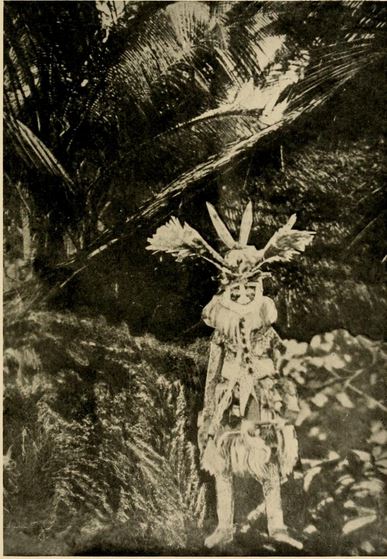
During the proper ritual seasons, Ilahita Arapesh men would wear hangamu'w [ritual masks/costumes], and personify various spirits;

These benign creatures, when they are at large in the village, move about begging small gifts of food, salt, tobacco or betelnut. They cannot speak, but indicate their wishes with various conventional gestures, such as holding a small coconut-shell cup on the end of their spear point as a sign that they would like to have some soup. The man who is approached (or the husband of a woman who is approached) cheerfully carries the desired item to the Falanga spirit house in the ward where it is deposited along with other booty, to be enjoyed by the wearer and by certain others of appropriate ritual standing.

Despite the playful, Halloween-like aspects of this practice, the hangahiwa wandafunei [violent spirits] were a much more serious matter. Ten percent of the male masks portrayed hangahiwa wandafunei, and they were associated with the commission of ritually sanctioned murder. These murders committed by the violent spirits were always attributed to Nggwal.

“Hangamu'w with crimped-leaf homicide badges.” from The Voice of the Tambaran (1980) by Donald Tuzin

“Hangamu'w with crimped-leaf homicide badges.” from The Voice of the Tambaran (1980) by Donald Tuzin

The costumes of the violent spirits would gain specific insignia after committing each killing, including homicide badges of crimped leaves (Cordyline terminalis) and the addition of bone ornaments. After the slaying of the first victim, the skull would be hung from the neck of the hangamu'w mask. After the second, a radius bone would be mounted in the left earlobe. For the third, a radius bone in the right earlobe, and a humerus bone would be mounted in the septum for the fourth. For the fifth, and all subsequent victims, a knotted rope would be draped around the neck to keep a record of each killing. “Word goes out that Nggwal has “swallowed” another victim; the killer remains technically anonymous, even though most Nggwal members know, or have a strong inkling of, his identity.” Tuzin writes that,

These hangahiwa wandafunei (the latter term being an adjective meaning "violent" or "hot-blooded" in a ritually powerful sense) are universally feared, and nothing can vacate a hamlet so quickly as one of these spooks materializing out of the gloom of the surrounding jungle. The reason why even men flee before it is that the spirits of its victims have putatively impregnated the mask. Thus, when an ordinary man dons one of these costumes he feels the "heaviness" of the mask, and the indwelling spirit(s) transform him into a compulsive killer; his own child or brother would not be spared if he came upon them. To this extent, the men are not entirely deceiving the women when they tell them that the hangahiwa are spirits incarnate. Traditionally, hangahiwa wandafunei sought out victims who were alone in their garden or on the forest paths at dusk. Pigs, dogs and chickens were also fair game. After spearing the victim, the offending hangamu'w would escape back to its spirit house. The wearer would replace it with the other costumes and emerge without fear of detection - in time to join the general alarm aroused by the discovery of the body.

Sometimes the wearer would not put the mask away, however, and instead he would take it to a nearby enemy village, where a relative or other acquaintance of his would take the mask and keep it in their own community’s spirit house, until it was time to be used and transferred once more. Through these ritual killings and the passage of costumes between communities, Nggwal impels cooperation between men of even hostile villages, and unites them in cult secrecy.

Nggwal, who travels in structures of fiber and bone atop rivers of blood.

"The spirit house of Nggwal Walipeine [the top initiation rank], Ilahita village." from The Voice of the Tambaran (1980) by Donald Tuzin

"The spirit house of Nggwal Walipeine [the top initiation rank], Ilahita village." from The Voice of the Tambaran (1980) by Donald Tuzin

Now we may ask, what service does Nggwal provide, considering his great demands? Nggwal was viewed as the collective aggregation of each unique spirit from every individual patriclan, and this united them into one powerful entity. In this way Nggwal helped stave off treachery between patriclans, “Premeditated betrayal, on the contrary, was out of the question: the offenders' own Tambaran [cult spirits devoted to Nggwal] would have wrought terrible vengeance on them for having thus abused his name. Even in the case of spontaneous outbreak, the combatants were inviting supernatural reprisal, and the knowledge of this went far in keeping tempers under control.”

Tuzin adds that, “It was sometimes expedient for enemies to call a temporary truce, especially in order to cooperative in a major cult undertaking.” Nggwal’s role in uniting diverse clans for purposes of ceremony and war points to some possible group-level benefits conferred by his presence, in aiding defense and territorial expansion;

When great occasions bring Nggwal (in "his" collective aspect) to the village, the unitary spiritual presence is achieved by congregating all its separate manifestations inside the tall spirit house, a supreme symbol of, among other things, the village's descent composition. By killing and warring under the aegis of Nggwal, emphasis is laid on the collective, village achievement, rather than on the exploits of particular individuals. When the deed is unambiguously singular, as in laf murder [murders committed by the hangahiwa wandafunei], the putative involvement of Nggwal is maintained by the anonymity of the killer. Uninitiated persons are led to believe that such deaths are caused directly by the spirits.

Clearly, however, there are areas where Nggwal benefits some people at the expense of others. Individuals of the highest initiation level within the Tambaran cult have increased status for themselves and their respective clans, and they have exclusive access to the pork of the secret feasts that is ostensibly consumed by Nggwal. The women and children are dominated severely by Nggwal and the other Tambaran cult spirits, and the young male initiates must endure severe dysphoric rituals to rise within the cult.

In a previous post on all male secret societies, I pointed out some of the common functional benefits they seem to provide, to individuals or larger groups: 1) the men’s house/secret rituals increase male cohesion, allow for larger cross-cutting alliances between clans through participation in the cult, increase community sizes, and thus promote more success in defense/war, 2) the men’s house lets men plan warfare excursions away from the women, who often have relatives in the enemy communities and might be at risk of running away and trying to warn them [the cults often seem to develop in societies with exogamous marriage exchanges with rival communities], 3) the men’s house and the dysphoric rituals imposed on the young men keep them away from the women, and this may benefit the older males in reducing reproductive competition, 4) the older men use the cult secrecy to their advantage to monopolize access to resources/knowledge/women when possible. The social control by the older males over the women, children, and younger male competitors may help sustain the cult, as once the younger males are old enough to gain status, learn the secrets and have influence, they start to benefit from the cult practices. All of these factors often seemed to be at play in the Tambaran cult and their devotion to Nggwal.

Note that the explanations above reflect both within-group and between-group dynamics. My understanding of entities like Nggwal and the other men’s cults I’ve written about fit nicely with the ‘self-interested enforcement hypothesis’ (SIE) of culture laid out by Singh et al. (2017), who write that,

Cultural group selection clearly occurs: practices and institutions diffuse across groups as societies subdue each other or observant rule-makers adopt them from their successful neighbors (Diamond 2005; see the Pama-Nyungan expansion for an example among Australian hunter-gatherers: Evans and McConvell 1997). The global pervasiveness of nation-states where tribes, bands, and chiefdoms once stood suggests that at least some cultural practices spread because of their effects on group-level properties (Flannery and Marcus 2012; Fukuyama 2011). But in emphasizing between-group selection, researchers have underappreciated the scope and extent of within-group processes based in self-interest, limited reason, and power. In fact, CGS is sometimes considered to be the primary or even only explanation for the development of group-functional norms and institutions (Boyd and Richerson 2002; Chudek and Henrich 2011). Richerson et al. (2016:16), for example, could not recognize how“ any of the alternatives to [cultural group selection] can easily account for the institutionalized cooperation that characterizes human societies.” Here we respond to Richerson et al.’s challenge by elaborating on how within-group processes—specified here as self-interested enforcement—can account for various aspects of rule design, including the creation of group-level benefits. The self-interested enforcement hypothesis (SIE) proposes that the design of rules reflects the relative capacity of cooperating or competing parties to enforce their preferences and the degree to which the interests of those parties overlap. Rules that promote cooperation, control conflict, and encourage success in intergroup warfare can thus emerge from the interactions of self-interested agents.

Social norms and practices can have group-functional properties, but they are also tools that can be manipulated and controlled strategically by self-interested parties.

Nggwal is no longer active these days. Decades of missionary and colonial activity have reduced the power of this once mighty entity. In 1984 several Ilahita Arapesh men rose during a church service and revealed the secrets of the Tambaran cult to the women. I’ll discuss that in a future post.

Moloch, as I understand the concept, primarily represents all the many ways people are disincentivized from cooperating—the “multipolar traps” and coordination failures, the general collective action problem to be found at the heart of many attempts at pro-social group endeavors. Nggwal instead is a truly impressively example of coordination—he is metaphorically and literally a collective that unites even enemy communities in displays of dominance and power. Nggwal as an entity symbolizes something of significant interest to me and a key focus of this blog: namely all the ways in which men cooperate to do extreme and destructive things to themselves and others.

Charlatanism: realms of deception and religious theater

In so far as individuals can always be found who misuse their authority to promote their own selfish aims, the [Inuit], in this respect, exhibit nothing peculiarly distinguishing them from any other nation - Hinrich Rink, Danish Greenland, Its People and Its Products, 1877.

Many social scientists have noted that humans are a particularly cooperative and interdependent species. One under-emphasized consequence of being such a cooperative and socially dependent species, however, is that we are quite vulnerable to deception from others. Put another way, people can sometimes benefit greatly by deceiving each other—individually or cooperatively with allies—in strategic ways.

Perspectives of human sociality often emphasize large, group-level benefits of human cooperation. For example, anthropologists Robert Boyd and Peter Richerson describe an evolutionary history where “natural selection within groups favoured genes that gave rise to new, more pro-social motives. Moral systems enforced by systems of sanctions and rewards increased the reproductive success of individuals who functioned well in such environments, and this in turn led to the evolution of other regarding motives like empathy and social emotions like shame.” However, sometimes the individuals who “functioned well in such environments” were not necessarily the ones with the most “pro-social motives”, but those who could effectively manipulate others. Part of functioning well, and increasing one’s reproductive success, in the extremely social environments of human societies, can revolve around taking advantage of the empathy and shame and trust and general ignorance of others.  

Inuit shaman of Greenland known as angakkoq or angakkut, despite commonly being considered some of the most productive and intelligent individuals in their society, were often reported to have had little compulsion about taking advantage of the status accorded them. Many angakkut would tell people that their souls were damaged, and offer to repair them, in return for a gift. Some would also claim the right to sleep with any man’s wife, and anyone who denied them that would be threatened with an early death or other horrible tragedies. One example during the early 18th century was described by Norwegian missionary Niels Egede. Anthropologist Merete Demant Jakobsen recounts the episode, writing that,

A young woman has denied the angakkoq his right to sleep with her and has been told that she will give birth to a seal instead of having children that could have been angakkut. Niels Egede is called to her bedside and asked to feel her stomach: ‘I said that it was not my profession to feel the stomach of women, and that it was impossible that it could be true’. He then asks whether she had eaten anything unusual and is told she had eaten raw barley. He suggests that she should drink water and the woman is well next day and convinced that he is stronger than the angakkoq as he can make seals disappear.

In the early 20th century, one angakkuq named Maratsi was described by Danish botanist Christian Kruuse thusly: “He has a difficult personality and has committed murders, theft, threatening women who will not sleep with him with soul stealing, and so on.”

Of course, this aggressive and nakedly self-interested conduct can generate a great deal of resentment, as I discussed previously in my article on sorcery. Jakobsen writes that,

The ambiguity in attitude among the Greenlanders to their angakkoq seems to be characteristic of the many encounters that [Niels Egede’s missionary father] Poul Egede meticulously reports. On the one hand they are seen to have great respect for their angakkoq and his skills, whilst on the other they seem to take any chance to get back at him because of the fear he induces and the power he possesses.

Another 18th century missionary, David Crantz thought that due to their “superior intelligence”, angakkut should, “be deservedly considered as the physicians, philosophers, and moralists of Greenland,” while also noting that their “intercourse with the spiritual world is merely a pretence to deceive the simple, and that their frightful gesticulations are necessary to sustain their credit, and give weight to their prescriptions.” Jakobsen adds that for many of the ethnographers who went to Greenland from the 17th to the 20th century, “The angakkut are seen as intelligent manipulators of their stupid fellow countrymen who are credulous and easily persuaded by any trickster’s performance.” Jakobsen gives a description of one such performance,

The spectators assembled in one of the houses after dark and then the angakkoq is tied, his head between his legs and his hands behind his back and the drum next to him. The light is put out and, while the spectators sing a song that they claim was made by their ancestors, the shaman begins conjuring and conversing with toornaarsuk, the great spirit. ‘Here the masterly juggler knows how to play his trick, in changing the tone of his voice, and counterfeiting one different from his own, which makes the too credulous hearers believe, that this counterfeited voice is that of Torngarsuk [a sprit-being], who converses with the angekkok’. The shaman manages to work himself loose and is believed to ascend into heaven through the roof of the house to meet with the souls of the angakkut puullit, the chief angakkut. Hans Egede [Poul’s son and Neil’s brother], although giving a detailed description of the séance, carefully establishes his own detached attitude to the performance. He has no doubt about the conjuring and falsity of the shaman’s work.

“The helping spirit amô, called by the tied up angakkoq, enters a house during a séance. The drum is seen floating across the floor. Karale Andreassen, The National Museum of Denmark. From Ib Geertsen (1990): Kârale Andreassen. En østgrønlandsk kuns…

“The helping spirit amô, called by the tied up angakkoq, enters a house during a séance. The drum is seen floating across the floor. Karale Andreassen, The National Museum of Denmark. From Ib Geertsen (1990): Kârale Andreassen. En østgrønlandsk kunstner, Atuakkiorfik, Nuuk.” From ‘Shamanism: Traditional and Contemporary Approaches to the Mastery of Spirits and Healing’ (1999) by Merete Demant Jakobsen†.

Due to their skill in performances such as these, as well their role in healing and executing witches or other sorts of criminals, Danish geologist Hinrich Rink noted in the 19th century the dilemma faced by missionaries in trying to end the power of the angakkut,

One of the first reformatory steps was that of doing away with the angakoks. As a matter of course the high priests of paganism could not exist in friendly harmony with the propagators of the new faith. But here two peculiar circumstances have to be kept in view. In the first place, on account of the amalgamation of religious observances with the social customs and laws, totally subverting the authority of the angakoks was the same as abolishing the only institution that could be considered to represent appointed magistrates and law-givers. Secondly, the class of angakoks comprised the most eminent persons, both as regards intellectual abilities, personal courage, and dexterity in pursuing the national trade.

The kind of self-interested deception and spiritual manipulation used by the angakkuts is given a greater scale and scope in the numerous all-male secret societies we see in the ethnographic record. I described many of these societies in a previous article, noting of the Amazonian and New Guinea cases in particular, where,

Male cult members whirl their bullroarers and play their sacred flutes in private, hidden away from the uninitiated. The women and children are told that these sounds are the voices of their ancestors, and spirit beings. Among the Ilahita Arapesh of New Guinea, men would wear full body costumes during cult ceremonials, while the women would be told they are materialized spirits. Men from neighboring villages were often asked to wear the costumes – and were given yams and sprouted coconuts in return – in order to prevent the women from suspecting it was males from their own community in the costumes.

Arapesh men’s ritual costume. From The Voice of the Tambaran: Truth and Illusion in Ilahita Arapesh (1980) by Donald Tuzin.

Arapesh men’s ritual costume. From The Voice of the Tambaran: Truth and Illusion in Ilahita Arapesh (1980) by Donald Tuzin.

As with many other societies with these sort of men’s cults, Ona hunter-gatherer men of Tierra del Fuego, would impersonate spirit-beings as a way to exercise social control over the women and children. The only European to be initiated into the Ona men’s cult, explorer Lucas Bridges offers a description of its origin and practices in his excellent book the Uttermost Part of the Earth (1948);

the men invented a new branch of Ona demonology: a collection of strange beings--drawn partly from their own imaginations and patly from folk-lore and ancient legends--who would take visible shape by being impersonated by members of the Lodge and thus scare the women away from the secret councils of the Hain [men's cult]. It was given out that these creatures hated women, but were well-disposed towards men, even supplying them with mysterious food during the often very protracted proceedings of the Lodge. Sometimes, however, these beings were short-tempered and hasty. Their irritability was manifested to the women of the encampment by the shouts and uncanny cries arising from the Hain, and, it might be, the scratched faces and bleeding noses with which the men returned home when some especially exciting session was over.

During Bridges’ own initiation into the men’s cult, cult members made loud shouts and yells while in the men’s lodge, and then cut themselves with glass and stone, and made their noses bleed using pointed sticks, to give the illusion to the women and children that they had to fight dangerous spirit-beings and protect Bridges from them during his initiation. Bridges also describes numerous examples of men impersonating spirit-beings and terrorizing the women and children. Bridges also floats the idea that at least some women might know what’s going on, but that they may pretend to be ignorant out of fear of being killed if they indicate they’re aware of the deception. Bridges also notes that the terror of the teen boy initiates before they become aware of the subterfuge is genuine, so the deception seems to have been remarkably successful in being maintained.

Of course, even with all of the violent coercion and deception of the men’s cults, as with the figure of the angakkut, we can point to some of the functions these kind of social roles and institutions play. As I wrote previously,

The presence of warfare and marriage exchanges with enemy groups offers some plausible functional explanations for the men’s cults. The men can plan their military excursions while in the men’s house, away from the ears of potential enemy sympathizers (their wives and the wives of the other males). The secret rituals and rites may help socialize young boys into becoming effective warriors. Herdt writes of the various functions of the men’s house: “These include military training, supervision and education of boys in the masculine realm, the transmission of cultural knowledge surrounding hunting magic and warrior folklore, the organization of hunting, some separation or recognition of the differences between men and women, the socially sanctioned use of ritual paraphernalia and musical instruments such as flutes and bullroarers, and so forth. These distinctive customs anchor the men’s world in the clubhouse throughout Melanesia.”

With the Inuit angakkuts and the men’s cults we are looking at the ways higher status males in particular used deception and religious justifications to dominate society, but spiritual manipulation has also been commonly used by lower status women in many societies to illicit important benefits, such as greater social standing and support. Anthropologist I.M. Lewis wrote of the way beliefs about spirit possession could used by women whose social position was insecure;

This sex-linked possession syndrome we are tracing seems to be equally prevalent in India and in South East Asia generally. In Utter Pradesh disaffiliated malevolent spirits, or ghosts, haunt the weak and vulnerable and those whose social circumstances are precarious. Thus the young bride 'best by homesickness, fearful that she may not be able to present sons to her husband and his family may label her woes a form of ghost possession'. And, 'if she has been ignored and subordinated, the spirit possession may take an even more dramatic and strident form as a compensation for the obscurity under which she has laboured'. Amongst the Havik Brahmins of Mysore, where as many as twenty per cent of all women are likely to experience peripheral possession at some point in their lives, the pattern is similar. Here it is again mainly insecure young brides (or older, infertile women) who are most exposed to this form of possession. More generally, women as a class are considered weak and vulnerable and thus easily overcome by spirits which, flatteringly, are believed to be attracted by their beauty. In possession, the spirit conveys 'its' demands, causing the husband and his family to mount an expensive ceremony designed to placate it and to persuade it to leave the sick host. Until waves have gained more secure positions in their families of marriage and have given birth to heirs, the illness is liable to recur, thus granting the sick woman all the attention and influence which she is otherwise denied.

Lewis adds that, “Women are, in effect, making a special virtue of adversity and affliction, and, often quite literally, capitalizing on their distress.” Ethnographer Gerhard Lindblom described women pretending to be possessed in order to get material goods from their husbands among the Kamba of East Africa, writing that,

Although the women are more superstitious than the men, it does happen that an intelligent and artful woman may make use of the spirits to get her own desires satisfied. For instance, she may for a long time have longed for a piece of many-coloured cloth, but her lord and mater has not been pleased to grant her desire. She pretends to be possessed, makes a terrible noise, and says that the spirit can only be appeased with a piece of cloth. To recover his lost domestic peace the otherwise dignified Kamba husband gives himself no rest till he has found the desired object, then the spirit disappears.

Lindblom also describes one such case where a married woman asked her husband to kill a fat buck for meat. The husband refused, as he had designated that animal for a religious offering the next time it was needed. Some days later the wife started twitching and uttering shrill cries, exhibiting symptoms that the Kamba consider to be the result of spirit possession. Her husband asked her what was the matter, and she conveyed that she was possessed by a spirit who wanted the buck meat. The husband went to hunt the buck, while the wife, elated at her success, began singing a lullaby to her child which contained lyrics mocking her husband for falling for her deception. Her husband happened to return earlier than expected and overheard her. Outraged, he ended their marriage and sent her back to her father.

That humans are particularly cooperative and reliant on each other to survive is undoubtedly true. Among individuals in every society—either on their own, or in coalitions with others—you’ll find people taking advantage of this fact.

The Momma's Boy Strategy: Why Bonobo Males Tend Not To Form Coalitions

Bonobos are unique compared to most primate species—and across mammals more generally—in being relatively female dominant. I’ve been working on a more comprehensive post about female power structures in mammals, but I figured I’d post something on bonobos in particular first.

Bonobos are moderately sexually dimorphic, with males being larger than the females. They live in multi-male/multi-female groups, tend to mate polygynously/promiscuously, have high male reproductive skew, and have female-biased dispersal, where the females tend to leave their natal groups while the males often stay in the community they were born in. Many of these factors tend to contribute to relatively strong male dominance, but bonobos are more co-dominant, and comparatively female-dominant compared to most other mammals. What explains this?

One popular explanation is the existence of female coalitions which constrain male dominance. The data on violent encounters in captive populations shows females are more likely to group together and attack a male, but many of these cases seem to represent sustained violent bullying of a lower-status male. Primatologist Amy Parish writes that,

Keepers at several institutions report that attacks appear to be provoked by male bluff displays or by male "nervousness," including "annoying" submissive vocalizations. Some attacks have been associated with external tension, as when unfamiliar zoo staff appeared with a hand-reared bonobo infant (Parish and Hamilton 1995). Attacks often occur outside any obvious context, however.

At the LuiKotale field site in the Democratic Republic of the Congo, female coalitions formed most often against individual males who were displaying aggression towards a female’s offspring, which may hint to some evolutionary history of infanticide by males, even though infanticide has not been observed among bonobos.  

The biggest question for me is: why don’t males form coalitions? While female coalitions may play some role in inhibiting male coalitions, I think there are two other main factors at work.

First, bonobos seem to have relaxed feeding competition compared to chimpanzees. Anthropologist Volker Sommer and his colleagues write that,

We found that chimpanzee diet is more diverse, whereas bonobos can rely on a few staple species for longer periods of time – which reflects the more seasonal climate at the chimpanzee site. Both species prefer fruit with elevated contents of water, sugar and fat, but chimpanzees have to cope with much higher levels of anti-feedants such as tannins. Moreover, only bonobos have access to a herb with low levels of fibre but high protein. In addition, chimpanzees invest more time and energy in the removal of seeds from fruit and in digestion. The costs of acquisition of high quality food are thus higher in chimpanzees than in bonobos. The greater constraints in terms of food availability and quality are reflected in greater levels of female-female competition as evidenced by consistently lower levels of gregariousness in chimpanzees measured through the size of nest groups.

Bonobo diets seem more likely to rely on abundantly available fallback foods, reducing competition for resources. So, this relaxed feeding competition seems to make it easier for female bonobos to form coalitions than female chimps, who have stronger female-female competition for food. Similarly, the ‘patchier’ distribution of high-quality foods in chimpanzee territories can lead the males to form coalitions and patrol the boundaries of their territory, to monopolize the best fruit patches where the females come to feed, and prevent rival males from accessing it. For bonobos, no such incentive seems to exist.

The second factor is the strong mother-son relationships bonobos form, and the key role this relationship plays in influencing reproductive success. Adult females and their sons spend more time close to each other, and more time grooming each other, than any other bonobo pair. Arguably this is the most important relationship in bonobo society.

Now, as with many other mammal species, bonobo males have linear dominance hierarchies, with the highest ranked male tending to win intrasexual fights with other males. The highest ranked male also tends to have the greatest reproductive success of any male in the group, fathering as much as 62% of the next generation. But importantly, mothers also play a key role in increasing her son’s reproductive success (and by extension her own) by helping her son get greater access to fertile females and have more mating opportunities. This is particularly important for middle and lower status males, who may not be able to successfully fight higher status males to move up in the dominance hierarchy. Primatologist Martin Surbeck and his colleagues write that,

Overall, higher ranking males were more frequently in proximity to oestrous females, but the mean number of oestrous females in proximity to mid- and low-ranking males increased when their mothers were in proximity. Except for the highest ranking male in the community, the mean number of oestrous females in proximity was higher when their mothers were also in proximity.

“Mean number of oestrous females in proximity of focal males in relation to absence (filled squares) or presence (open circles) of the male's mother. For all but the highest ranking male, the number of oestrous females in proximity was higher when t…

“Mean number of oestrous females in proximity of focal males in relation to absence (filled squares) or presence (open circles) of the male's mother. For all but the highest ranking male, the number of oestrous females in proximity was higher when the mother was also in proximity.” From ‘Mothers matter! Maternal support, dominance status and mating success in male bonobos (Pan paniscus)

Notably, there are examples of bonobo mothers helping their sons sexually coerce other females. Primatologist Klaree Boose writes that,

We observed 56 attempts of direct sexual coercion performed by two males with a combined success rate of 71.4%. Of the two males who engaged in direct sexual coercion behaviors, the son of the alpha female (Gander) participated in direct sexual coercion events significantly more than any other male. We also observed that all but two females were targets of direct sexual coercion, where only the alpha female and mother to Gander (Unga) and mother (Susie) of the previous alpha male (Donnie) did not receive any direct sexual coercionconflicts in which [Gander] was involved were almost always met with coalitionary aggressive support from his mother, the alpha female, who was frequently observed to engage in intense forms of retaliatory aggression including physical contact that would often result in the wounding of targets. All individuals in this group were highly deferent to the alpha female, and she received the least amount of aggression from males during the course of this study. Furthermore, females were found to be most receptive to her son’s solicitations for copulations. Evidence that mothers impact the relative dominance rank and subsequent mating success of their sons has been demonstrated in a wild population of bonobos (Surbeck et al. 2011). It is likely that this male’s relative dominance rank was effectively as high as his mother’s when she was present in the party and, therefore, reduced his likelihood of receiving retaliation for his attempts to directly sexually coerce a female. Our data that the success rate of direct sexual coercion attempts was dependent upon presence of the mother of the aggressor support this hypothesis. We also observed several instances of coalitionary sexual coercion (N=11) where the alpha female supported her son during his attempts to directly sexually coerce three separate females, including two parous adult females (Ana Neema and Lady), neither of whom were close associates of the alpha female.

Putting it all together, here is what I think is going on: there seems to be two fruitful reproductive strategies available to males—either through success in the linear male dominance hierarchy, winning conflicts with other males to increase access to fertile females, or through maintaining a strong bond with their (preferably high ranked) mother, which increases male access to fertile females. You might think that middle status males would join together to overthrow the disproportionately successful alpha, but consider the cost: they’d be reducing the time spent with their mothers, and by extension in the vicinity of oestrous females, to develop a same-sex coalition with no guarantee of success. There is a coordination problem in getting such an initiative started, with the costs of spending reduced time with the mother simply being too great.

For lower status males, here is where I think female coalitions might play a role in inhibiting male dominance, through preventing lower status males—who may not have their mother around, or whose mother is similarly low ranked—from developing effective alliances. I’m speculating based on limited information here, though.

Associated with this, I think the long period of pseudo-estrus found among bonobos, with more consistent non-conceptive sexual behavior, also plays an important role in reducing male dominance over females. Surbeck and his colleagues write that,

Results of the present study indicate that female bonobos derive a source of leverage from the reduced predictability of ovulation, possibly because male reproductive success becomes contingent on proceptive behaviors by estrous females. Bonobo females at LuiKotale were more likely to win a conflict when they were maximally tumescent [swollen].

It seems that the males may defer to fertile females, perhaps to stay in their good graces and have increased sexual access to them.

So, we might again think of the possible fitness strategies available to males: 1) win fights with other males and become the (intrasexual) alpha, or 2) have a higher ranked mother who gets them access to fertile females, or 3) if low ranked, be generally well-liked or inoffensive enough to the females to take advantage of mating opportunities without alienating them. Noting again the lack of feeding competition, none of these scenarios seem to lend themselves well to male coalitions.

The close mother-son bond in particular, in my view, contributes to the (relatively) more peaceful intersexual relationships between males and females among bonobos, even though some sexual coercion does seem to exist.

One final note: there is difficulty in comparing bonobos (or chimps) to humans, because of some of the unique constraints each species faces. For example, bonobos may sustain more peaceful intersexual relationships by virtue of more consistent sex due to prolonged pseudo-estrus, paternal uncertainty, and sperm competition reducing infanticide and direct male-male violent competition for sexual access. In humans, this strategy can have the opposite effect, where paternal uncertainty leads to ubiquitous social institutions that regulate female sexuality, and having multiple sexual relationships can lead to reduced male and kin investment into their highly altricial infants, increase the risk of infanticide, and lead to greater male-male conflict over sex.